Monday, 24 February 2020

The role of educational institutions in constructing stereotypical role models of persons and structures to perpetuate the existing unjust social order through curricula, admission and appointment policies, governance, values, norms and the like.


………………………………………………………………………………………………………
Introduction
Education is a tool to empower the individual and it has brought about phenomenal changes in every aspect of people’s life. India has its own indigenous education system and in India education was not foreign in origin. When we are under British rule, they formed institutions, universities, and implemented English education. Institutions play a great role in development. New development cannot take place without the establishment of new institutions. Today, establishment of new colleges and universities has been based on political rather than academic considerations[1].
1) Etymology: - The word education has derived from the Latin word ‘educare’ which means ‘bring up’, ‘to bring forth’. In other words education means to lead out of ignorance. Education is important one in our life and it is a continuous process; it provides the individuals to develop their mental, physical, social and emotional qualities[2]. It is one of the vital needs of every individual and society which should spread as a movement[3]. Education begins immediately after the child is born and continues till his breath in some way[4].
2) Purpose of education: - The chief purpose of education is preparing the present for the future.  The aims and objectives of education itself in any society are influenced by various factors like the history of the society, social patterns, economic and political systems. It is true in India, due to changes in its socio-political fabric; the educational scenario has undergone modifications in curriculum[5].
3) Ancient education system
F.W.Thomas remarks, Education is no exotic[6] in India. There is no country where the love of learning had so early an origin, lasting, powerful and influence. But the educational system was not a universal one, narrow, partisan and discriminatory[7].
(a) Gurukula system:- During vedic period Gurugula system of education was followed[8], there existed a clear bond of academic relationship between the provider of knowledge (the Guru) and the seeker of Knowledge (the Shishya) even though institutionalization of any formal kind was yet to be established at that time[9]. Education was given to all, no caste and sex difference exist. Girls were educated at home and they taught music and dancing[10], allowed to learn Vedas and Upanayana, and later gradually lost their right to learn[11], education was prohibited to physically and mentally challenged. Every student serves his teacher by doing duties and they obeyed the guru fully. Students memorized the lessons presented orally by the teacher, the second lesson was taught only when the first had been memorized. Meditation, pronunciation of words and discussion took place in gurukula[12]. The duty of the teacher was to take care and give medical treatment[13]. The curriculum was the guru’s ways of life, actual instruction and practice were yoked together. The learner –motivation for skill acquirement was propellant in the Guru-shishya system[14].
(b) Religious system:-During the middle ages, education in India was essentially religious in its orientation.  Indian caste system restricted formal education to the men from dominant castes. The Hindu system of education considered three stages in the learning process. (i) Sravana, one hears the vedic texts read and explained by a teacher. (ii)Manana, is reflection of what is heard. (iii) Nididhyasana, continuous meditation leading to an intuitive realization. Later this system developed into two types of education- elementary and higher learning. The Tol was the school of higher learning, Sanskrit was their medium of instruction and it was religious in character[15], bratas for women education[16] and pathasasla for elementary education. Buddhists continued with the same two types of education, but it is open to all. Muslims had elementary schools (the maqtabas), commonly attached to the mosque, which taught students to read especially the Koran and to write. The centers of higher learning (the madrassahs) prepared a selective group of men for professions, like priesthood, judiciary and medicine[17]. Farsi[18] schools – impart training in Farsi language and literature[19]. It was mostly the higher and middle class who are few profited from the education[20]. They were generally one teacher, hardly controlled by state and no centralize system exist. The teachers played a pivotal role, followed certain established traditions and norms of education which differed from place to place. Modes of financing these institutions were different. The tols and madrasahs were fully supported by land endowments, while pathshalas depend solely on fees and occasional gifts from villagers. The pathshala became wide spread, covering all class of local people[21].
(c) Institutionalized education system:- During the transformation from the gurukula to religious society, a gradual institutionalization of the system of education has emerged as evidenced by Nalanda, Takshila[22], Ujjain, Vallabhi in Kathiwad, Nadia in Begal, Kanchi in Tamil Nadu, and Nagarjunakonda in AP attracted scholars from all over India and abroad. Arts, humanities, sciences and Technology flourished at these universities. The contributions of eminent scholars like Aryabatta, Varamihira, Bhasa, Carvaka, Nagarjuna, Kautilya and others in the fields of Mathematics, Astronomy, Physics, Chemistry, Medicine and state craft are universally recognized and respected[23].
4) Education in modern India
Indian universities and modern higher education owe their origin to the British Raj[24]. After the arrival of the British in India, sweeping changes in the sphere of education have taken place[25]. They left the legacy of English medium institutions to our nation. Fee-levying English medium schools sprang up everywhere. The education system in our country virtually deteriorated and collapsed, owing to the uncontrolled growth of these schools[26]. The Guru-shishya system got slowly diluted. Emphasis and importance was bestowed upon certification rather than acquiring skills, there by paving way for a kind of commercialism to creep into the system of education[27]. We are continuing the same structure of higher education that we inherited from British[28]. These schools are under the constant “Tyranny of text books”.  The system is text book oriented. Pupils are taught to memorize and vomit at the time of examination, and these schools can be called as “Parrot schools”[29]. We have the most rigid education system in the world that is the separation of academic and vocational subjects which is responsible for poor progress in vocationalism[30].
(a) Categories of education: - The education system is divided into many divisions namely, Pre-primary (3-5years), Primary education (5-10years), secondary (10-15), higher secondary (15-17), and higher education (degree courses, P.G courses, M.Phil, Ph.D etc.). Universities are the centres for higher education, which includes engineering, medical, agricultural etc[31].
(b) Problems of modern education: - Education has become a marketable commodity. The entry of private enterprise in education will continue to increase and it cannot be prevented. Now the government has started regulating fees and admission procedures in institutions. It results in wastage of time, and the complicated procedures stipulated by the governments make a delay in completing the admission formalities. Students have purchased their seats and they have no respect to teachers or management which leads to indiscipline in campus. The university system gets politicized when the executive and the judiciary become subservient to a party[32]. Those who have acquired “free” government seats are facing ever higher demands of donations which tend to drive their families into debts and the successful candidates move into corrupt practices in their later professions in order to settle those debts.
The examination system favors memorizing rather than critical inquiry, practical development and application skills. As a result school leavers are satisfied to move into white collar jobs however dull the work may be where as the dropouts, considered as failures move into manual labor jobs. The top- performers are recruited even before they leave the colleges, by companies which expose them to new sorts of brain washing which isolate them from the social background from which they originate. They are not only receiving training for particular skills, but are temporary transplanted into the luxury “life world” of five star hotels in order to turn them into loyal servants/consumers/ defenders of the new order of the rich without asking any more questions[33].
(c) Reformation in modern education system: - In a democratic country the educational system should be free, free from government control. But monitored, evaluated and supported by the public. A system whose individual institutions are accredited by the teaching community which is flexible and student oriented. The teachers will teach what the student wishes to learn, apart from what stipulated as a minimum requirement by state. The students will be guided in choosing the subjects of study by their parents and teachers. A student oriented educational programme would naturally be a credit based system. Financial support and management would be evolved by the public in which state would provide funds depending upon the requirements[34].
(i) Admission: - The teacher would decide who is to be admitted to his class and when to close the admission to his course. The teaching will be based upon the capacity of the students; it will be imparted through a method that is best suited to the students in the class. The evaluation by the teacher will be continuous, and student will have the option to declare when he is ready to take the final test. In which student may take as many credits as he likes and may study at his own pace and complete his course[35].
(ii) Curriculum: - The curriculum must necessarily include apart from the learning of the state language, the elements of Mathematics, ethics, the duties and rights of citizens, and other essential details for pursuing a useful life. Apart from curriculum the teachers in consultation with the parents can prepare curriculum. The syllabus has to be the responsibility of the district educational committees which should be constituted with the members of the public of the village, union or the districts as the case may be and representative members of the teaching community of the relevant region[36]. Teaching of our own literature and teaching through the state language.
(iii) Law: - The constitution of India acknowledges education as right in its Directive principles. It also contains several provisions with regard to the poor and the minorities. In practice this right has been denied to many most so to women and members of scheduled castes and tribes. The struggle for better education is bring the directive principle of the constitution into practice by making formal education accessible for all. Freedom to learn and freedom to teach should prevail in order to sustain democracy.
(d) Alternative education: - Instead of spending all energies on getting a limited number of marginalized people admitted into the present exclusive system. An educational system should be develop based on human potential of children, not to make them fit for competition, but to equip them with values and skills of co-operation and mutual care as the basis for survival. Education is diverse to cultural and natural environment rather than to text books. Apart from such alternative education there is a wave of training in all sorts of fields[37].
Conclusion
Education in India is old which was altered by the societal, cultural, and religious values resulted in a form of institution. Arrival of British again brought change in education and new system of education based on text books emerged. That mode still exists which has lot of flaws in which educationalists and reformers are gazing for an alternative system. The contemporary education system is based on competition. Education should be based on diversity of gifts one possesses and make students mutually enriching by developing cooperation instead of competition. The education process would further as regard on the development of life skills which will provide a means of livelihood. Part of this would be an environmental awareness of the need to maintain the physical surroundings and to live in a sustainable way.

Bibliography
Abel,M. Ideals and reality, Madras: CLS, 1995
Crook (ed), Nigel. The transmission of knowledge in South Asia, New Delhi: Oxford university   press,1996.
Dietrich, Gabriele and Bas Wielenga, Towards understanding Indian society, (Madurai: TTS),      1997.
Jeyaraj, Nirmala. Higher education, Lady Doak College, Madurai, 1998.
Manohar (ed), Moses.P. Education in free India, New Delhi: NCCI/ISPCK, 1998.
Shiny,K. Education in the emerging Indian society, Kanyakumari: KSM Educational and             charitable Trust, 2010.


[1] Nirmala Jeyaraj, Higher education, (Madurai: Lady Doak College) 6.
[2] K.Shiny, Education in the emerging Indian society,(Kanyakumari: KSM Educational and charitable Trust) 1.
[3] Moses.P.Manohar (ed), Education in free India (New Delhi: NCCI/ISPCK) 4.
[4] K.Shiny…1.
[5] Nirmala Jeyaraj…114.
[6] Originating in foreign counttry
[7] Moses.P.Manohar…24.
[8] K.Shiny…12.
[9]Nirmala Jeyaraj…114.
[10] K.Shiny…12.
[11] Moses.P.Manohar…24
[12] K.Shiny…13
[13] K.Shiny…12.
[14] Nirmala Jeyaraj…114.
[15] Moses.P.Manohar…25
[16] Nigel Crook (ed), The transmission of knowledge in South Asia(New Delhi: Oxford university press)98.
[17] Moses.P.Manohar…25
[18] Court language during Mugal rule
[19] Nigel…98.
[20] Moses.P.Manohar…25
[21] Nigel…98.
[22] Nirmala Jeyaraj…114.
[23] M.Abel, Ideals and reality, (Madras: CLS) 1.
[24] M.Abel…1.
[25] Nirmala Jeyaraj…114.
[26] Moses.P.Manohar…17
[27] Nirmala Jeyaraj…114.
[28] Nirmala Jeyaraj…8.
[29]Moses.P.Manohar…17
[30] Nirmala Jeyaraj…11.
[31] K.Shiny…114.
[32] Nirmala Jeyaraj…12.
[33] Gabriele Dietrich and Bas Wielenga, Towards understanding Indian society, (Madurai: TTS) 250-251.
[34] Nirmala Jeyaraj…78.
[35] Nirmala Jeyaraj…80
[36] Nirmala Jeyaraj…89.
[37] Gabriele…250-253.

Sunday, 23 February 2020

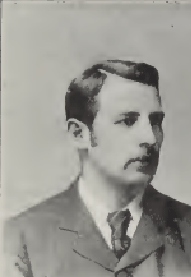
ARTHUR FELLS, South Travancore, LMS Medical Missionary


ARTHUR FELLS, M.B., CM.


In January 30, 1893, Dr. Arthur Fells arrived at Neyoor, Travancore, to release Dr. Fry for service as secretary and superintendent of the Edinburgh Medical Missionary Society. Fells has entertained the desire of becoming a missionary since he left school, and, having served an apprenticeship under a chemist at Warminster (where he joined himself to the Congregational church, and engaged in Sunday school work), and studied medicine in Edinburgh, he is entering upon his future work with the deep conviction that medical mission work is the most Christ-like of enterprises, that it offers the means of gaining the readiest entrance to the hearts of the people, and that the need for such ministry is greatest in the vast heathen world.

While at Edinburgh he took part in the work of the Cowgate Medical Mission, and was connected with the Children’s Church belonging to that Mission, taking charge of the church during the latter part of his period of study. He also visited common lodging-houses, and helped at services for patients, evangelistic meetings, etc. The Directors are indebted to the generosity of Dr. Gauld and the Committee of the Old Ford Medical Mission for releasing him from an engagement into which he had entered with them. Prior to his departure Dr. Fells was united in marriage to Miss Jessie Reiach, of  Edinburgh, who accompanied him to Neyoor. Ramsgate being Dr. Fells’ home, a farewell meeting was held in the Congregational church (of which he was a member) on December 1st, under the presidency of the pastor, the Rev. J. B. Evans, the opening devotions being led by the Rev. J. Wall. Mr. Hinds and Mr. Pool, on behalf of the Sunday-school and church respectively, expressed hearty good wishes for Dr. Fells, who in turn addressed the meeting. The Rev. R. Wardlaw Thompson described the character of the work being done at Neyoor, after which the Rev. J. James, of Margate, offered a valedictory prayer. Dr. Fells’ father also spoke at the meeting.

Dr. Fells, was a highly qualified and dedicated physician who took over the South Travancore Medical Mission. A great challenge was awaited when Dr. Fells as South Travancore medical mission in-charge because South Travancore was in the grip of epidemics that broke out consequent to a famine caused by an unprecedented drought that lasted for three years. The famine and the epidemics were so devastating that people died like flies. Numerous people died in and around South Travancore during the famine Dr. Fells took the leadership to open a number of dispensaries all over South Travancore. Fells, wrote in his report for 1900 about the Maharaja who was "always a true friend” of the mission.  
He was an expert in treating cancer, he took more care in treating the patients. During his work period more than 75,000 people were treated. It was at this time the number of branch hospital increased from nine to thirteen. As a surgeon he has done surgery for nearly 5,000 people. He called the assistants as “Medical Fellow Missionaries”, and because of his efforts and the success of Neyoor Hospital with other branch hospitals, the South Travancore medical mission was made as “largest medical mission in the world”. He chose well talented persons/ evangelists from mission and trained them as compounder, nurses, and medical personals. Those medical trained people are engaged in mission fields, which allowed Fells to reduce the expense of medical mission.


Wednesday, 26 July 2017

G. Christhudhas - a Historian

History had been written by countless persons during the nineteenth century, and it was mainly through the Western writers. They believe that the sons of soil have no history and tried to make it down in written format and so numerous volumes of Books on History, culture and missionary activities has been printed. But we have our history in Oral traditions, Tamil literature books, and some in pamphlets.  The students of History studied the books of English men which glorified them and considered the natives as low, and condemned them as evil and their culture as devilish. But the recent development in the history of Christianity has changed everything and they tried to bring out the history of the people. The Church History association has taken immense measures to bring the history of the people and has published it as Books. Those books are dealing with large portion of the history, but the regional or local history is not given much importance.
Christhudhas was the Bishop of CSI Kanyakumari Diocese from May 1, 1980- January 7, 1997. His period was an epoch of Progress. After his retirement he sought to write the history of Church at Kanyakumari. He has written two books on the history of protestant church in Kanyakumari District, Namely Paathachuvadukal (Foot Prints) in Tamil which made him to write an elaborate book in English as “Precious Profiles” – The work of the LMS in South Travancore (CSI (1795-2009)). His works must be appreciated because it deals a very large era from beginning of mission to 2009. The books were systematically written, portraying the Liberation of the oppressed community. He has a good ability to do research and synthesized in a proper perception which makes his findings authentic. He has rendered a wonderful service to Church of South India and very particularly to the people of Kanyakumari.
He has tried to locate the history of the church in the context of the political history of India. No community’s history can be an isolated history; it has to be part of the National history. He has located the History of his community in the context of the political history, which is a pioneering effort. The history of his community is a liberation history; it is also a salvation history. The spiritual history of the people involves other aspects of life such as tradition, culture, economy, political and religion. For a person who is interested in mission it is about the history of mission.

A historian is the one who is an expert in history; who has authority on history, a writer of history, chronicler, and one who produces a scholarly synthesis. Historians research, analyze, interpret, and present the past by studying historical documents and sources. So Christhudhas through his valuable research has interpreted the past and presented it in a Scholarly manner. And so he can be called as historian. 

Sunday, 11 June 2017

FAMILY CONCERNS AND RELATED ISSUES

INTRODUCTION
Problems in families will lead to growing number of family break down and divorces. Today people are not concerned about family concerns like marriage, sex & family planning. But as Christians, we should be aware and concerned about families. The family life starts from marriage.
            Marriage is one of the most interesting and important subjects in the world. Everyone enter this world through the physical union of a man and a woman. Every culture in the world has its own set of customs and rules concerning marriage, sex and family. What God have to say about marriage, family and sex? Since it was God who created mankind as male and female and He joined the first man and woman together in marriage. So it is very important to understand what God has to say about marriage, sex and family.
MARRIAGE
Marriage is a social union or legal contract between individuals that creates kinship. It is an institution in which interpersonal relationships, usually intimate and sexual, are acknowledged by a variety of ways, depending on the culture. Such a union may also be called matrimony, while the ceremony that marks its beginning is usually called a wedding and the marital structure created is known as wedlock. People marry for many reasons, most often including one or more of the following: legal, social, emotional, economical, spiritual, and religious. These might include arranged marriages, family obligations, and the legal establishment of a nuclear family unit, the legal protection of children and public declaration of love. Marriage practices are very diverse across cultures, may take many forms, and are often formalized by a ceremony called a wedding.
1)    Marriage was God’s idea
            Marriage was God’s plan from the beginning. It was not man’s idea. Marriage was planned by God to meet the human need for companionship, love, mutual encouragement, practical help, and sexual satisfaction (Gen.2:18, 1Cor.7; 2-3).It is God’s plan that marriage should be the way in which children will be born and raised in the security and love created by one man and one woman, committed to each other for a lifetime (Ps127:3, Mal.2:14-16, Mat.19:6). When God created Adam in the Garden of Eden, He created a perfect man. But there was one thing Adam needed. God said,” It is not good for the man to be alone. I will make a helper suitable for him” (Gen.2:18).God decided to make another human being like himself. Adam needed the companionship of another human being like himself. God had made the other creatures as male and female (Gen.6:19).Since Adam was a male; God took one of Adam’s ribs and made a female partner for him. By doing this, God gave Adam a lifelong companion and helper and a sexual partner for marriage. Through the physical union of Adam and Eve, God planned for the human race to be continued (Gen.1:27-28, 2; 24).
2)    Marriage was the first thing God established in human society
Marriage was established by God before all other human institutions. This shows us that marriage is the foundation of human society. Marriage was established before man’s fall into sin. This shows us that marriage is Holy. In God’s plan, marriage is the basis for a morally and socially stable society. This is part of the reason why God hates adultery (Ex.20:14), fornication (1Thess.4:3-6), incest (Lev.18:6ff) and homosexuality (Rom.1:24-28).These things disrupt and twist God’s plan for a stable human society. Marriage is God’s plan for all people and all cultures in the world.
3)    God’s plan about marriage
God’s plan is that there should be one woman for one man. God made one woman for the man, He created (Gen.2:22-24).He intended for this partnership between one man and one woman to last for a lifetime. This lifetime commitment is important for several reasons. First, it guarantees care, provision and protection for the wife through out her life (Col.3:12, 13, 1Pet.3:7). Second, there is a need for the emotional security and development of the children. Third, Children need a secure and environment to grow and develop the way God intended.
4)    Is marriage bondage?
Many people think that marriage is bondage. But marriage is an agreement between two persons, a man and a woman, in which they willingly and voluntarily, bind each other in a life long bond. The bond remains till they are separated by death. In other words, marriage is meant to be extremely string and unbreakable and expected to be permanent and long-lasting. So marriage is not bondage, but a complement and a supplement.
5)    Problems in married life
Problems in married life are various and have many reasons. It may be because of suspecting each other, comparing with others, and interference of the in-laws and lack of financial freedom. Some other reasons are social, financial, physical problems, spiritual, mental, moral and emotional problems cause more harm to them. Each couple from the very first day till their separation at death faces problems. Those who confront those problems with courage and defeat them will lead a happy and fruitful life.
SEX
Sex is a process of combining and mixing genetic traits, often resulting in the specialization of organisms into a male or female variety known as a sex. The word sex is also used for sexual intercourse and gender.
Sex is a powerful force. It is something like fire. Fire is possible because of the way God made the world. Fire can be very useful. We can use fire to cook our food and to heat our homes. But if a house catches fire, it can destroy the house and even kill the people in it. The same is true about sex. Sex is possible because of the way God made men and women. Under God’s control, sex is one of god’s blessings to married people. It is the means of great pleasure and the means of bringing children into the world. Out of God’s control, sex can destroy the home and ruin human lives.
1)    Is sex a sin?
            This is a question that many young people ask today. A straight and clear answer to this from the Bible is “YES, it is a sin when out side a marital relationship”. Practices such as adultery (unfaithful to a marriage partner), fornication (Sexual relations before marriage), homosexuality (sexual relations between people of the same sex), incest (sexual relations between family members), bestiality (sexual relations with an animal) and other impure practices are an abomination to God. God gives us a list of those practices which are impure forms of sexual behavior. God has pronounced a severe judgement on these sins (Lev.20:10-21).
2)    God’s plan concerning sex
            When God created man, He created them as male and female for the purpose of sexual reproduction (Gen.1:27-28). One of the most important facts a Christian must understand about sex is that sex was God’s idea for man’s good and man’s enjoyment. It is not a sin within marriage. According to the Bible sex is both good (Gen.1:31) and (heb.13:4).it was given to man before his fall into sin in the Garden of Eden. Some people believe that the original sin of man was the fact that Adam had sex with his wife (Gen.4:1). This is a false idea. Because of sin, man has twisted and corrupted God’s plan concerning sex. According to God’s plan, sexual relations must be strictly confined to husbands and wives in the commitment of marriage.
3)    Sexual sins and its results
            Any other use of sex outside of marriage is a serious sin. Many terrible problems in the world today are the result of a sinful use of sex. Some cultures do not condemn certain sexual sins, such as fornication. If a Christian comes from such a culture, he or she must understand that it is God who has condemned fornication and other such sins. Another sexual sin is perverted sex. A terrible outcome of this perverted sexual relationship is the dreaded disease like AIDS. AIDS (Acquired immune deficiency syndrome) is caused by a virus called HIV (Human immunodeficiency virus) it is widely believed that it is originated from unnatural sex and now spreads all over the world so rapidly. Often people didn’t understand that this is a curse from God on the immoral society. Most of the sexual diseases are from unnatural sex and unfaithful partners. The disease which spreads by sexual intercourse is called as sexually transmitted Disease (STDs).
FAMILY PLANNING
            The condition of family life is reflected in the condition of the nation, so high priority should be given to the development and delivery of health and welfare services. These services should include family planning services, since family planning is intimately connected to the core functions of the family; procreation, socialization and acculturation of children.
            Family planning is the responsibility of the parents to make conscious decisions regarding the number of children they want and their spacing. Data is available which support family planning as a preventive health measure.
Definition
            Family planning is frequently used to mean that people plan when to have children, using birth control and other techniques to implement that plan. Other techniques commonly used are sexuality education, prevention and management of sexually transmitted infections, preconceptional counseling and infertility management. Family planning is sometimes used as a synonym for the use of birth control, though it often includes more.
Family planning Association India (FPA India)
            This organization was established in1949, which has been recognized as India’s leading and largest reproductive and sexual health organization. It provides information on sexuality education and family life and a wide range of services in sexual and reproductive health, including family planning, bringing health and happiness to millions.
Functions of FPA India
            FPA India strengthens a voluntary and non- government commitment to promote sexual and reproductive health and rights including family planning. It supports the rights of individuals to reproductive choices, including legal and safe abortion. Works towards reducing the spread and impact of STIs/HIV/AIDS, and increasing access to gender sensitive. SRH information, education and services to all especially the young and marginalized and eliminating violence, discrimination, and abuse.
Benefits of family planning
            It improves the health of men, women and children.
            It reduces the unwanted abortions.
            It helps the children to get good health, food, education, emotional support from parents and other resources.
            It reduces strain on environmental resources (land, food, water) and community resources (health care & education).
            It gives better health for women.
Focus on family planning by Christianity
Roman Catholics
The Roman Catholic do not accept family planning as they consider children as gifts of God. Catholic doctrine holds that God created sexual intercourse to be both unitive and procreative. This church considers deliberately altering fertility or the marital act with the intention of preventing procreation to be sinful. Thus, artificial birth control methods are forbidden, as are acts intended to end in orgasm outside the context of intercourse. At the same time, not having sex at all is considered morally acceptable. Having sex at an infertile time in a woman’s life is also considered acceptable, since the infertile condition is considered condition to be created by God, rather than as an act by the couple.
Family planning according to the Bible
            When the Lord blessed the nations, he said that mankind shall multiply and fill the land. When he gave such a blessing, he only meant to fill the land, but not to congest it with too many people. He only wanted to multiply the generations, but not the number of people. We know that “ too much of anything is good for nothing” hence it is very important to keep with the limits. Therefore it is not wrong to practice family planning.  
DOWRY
What is dowry?
            Dowry or ‘Dahej’ or Sreedhanam’ is the money, goods or estate that a woman brings to her husband in marriage. It’s the gifts given by the bride’s family to the bridegroom’s family along with the bride in Indian marriage. Kanayadanam is an important part in Hindu marital rites. Kanya means daughter and Dana means gift. The present made at the time of marriage in the form of cash, ornaments, clothes, or articles shall be deemed to dowry.
Origin of dowry
After the completion of his education at Ashram, when a young man married and began life he had no property or money. To launch him in the world, society provided him with the articles barely necessary and enough to furnish his house hold. The parents of the bride naturally were the main contributors. The gifts were mainly clothes and utensils and a cow supplemented with some ornaments for the bride and some money.
Dravidian culture
            The Dravidian culture has its own language, vast number of classical literature, well developed art and music. They even have their own religious in earlier times. This religion was not Hindu. It also appears that they had no dowry system as it is known today. But after the introduction of braminical religion into, Tamil country dowry crept in and the status of women began to sink.
Dowry and Christian concept of marriage
            The Christian concept of marriage is that God institutes marriage. In other words, we regard marriage as an order of creation. To make it more specific, marriage consists of a covenantal relationship between two people. And this is to fulfill the purpose of God. Also marriage is regard as a social and religious institution. The main emphasis in marriage is mutual love, respect, faithfulness to each other and responsibility for one another. It is a meaningful relationship.
            Since dowry is one of the main criteria in marriage, woman receives love and respect according to the amount of dowry. And there is bargaining tendency on dowry in the marriage; it reduces the sacramental value of marriage. Many people give more importance to money than to the personal worth of the people and human relationship.   
So marriage on many occasions is dependent upon the external or material things rather the value of the person, worth of human personalities. So it becomes difficult to agree in such cases marriage is an ever lasting contact of relationship between two people or the union of two hearts. This is the main reason dowry is called as social evil. The real meaning of the marriage has lost its value and the women are made as commodities without having any individual worth with the marriage.
Disadvantages of dowry system
o    Many girls from the middle class and low class families remain unmarried.
o    The parents who have more number of girl children will be in heavy debt after two or three marriages.
o    The bargaining nature of the dowry introduces commercialism in marriage and so the sanctity of marriage is lost.
o     Girls are not encouraged to get high education. The dowry system may psychologically affect girls.
DIVORCE
            The word Divorce is derived from the Greek word “apaulo” which means “ to  set free, to loose, liberate, dissolved, cut loose, or a ship at its launching, discharge, as a soldier from the army, cut a part to cause all obligation and responsibility to cease.” The meaning in dictionary is “the legal ending of marriage”. Divorce is becoming a serious problem in the modern world, especially for those who live in big cities.
History
In contrast to the Western world where divorce was relatively uncommon until modern times, divorce was a common occurrence in at least two pre-modern societies: Japan and the Muslim world.
Ancient history
            Divorce is mentioned in the Code of Hammurabi, the oldest known written compilation of laws. Believed to have been recorded around the year 1760B>C in Babylon, Hammurabi believed himself chosen by God to deliver laws to his people. His rules for divorce imply that the practice already existed in his time, might possibly be the origin for the concept of fault divorces. According to the code a man could divorce his wife if she went out of doors uncovered persisted in acting foolishly or belittled her husband.
Greco Roman History
Ancient Greece was one of history’s most sexually permissive societies. It’s not surprising, then that divorce should have been quite common in their society. The matter was a legal concern, and it required approval by magistrate subject to appropriate grounds. It was only after the city state had grown into a republic and an empire that wealthy Romans began to see divorce more liberally
  Medieval period
During the period after the Roman Empire during which the Catholic Church was the central social and political institution in the west, divorce fell into decline. When we read the gospels, Jesus says that divorce is same as committing adultery. Since adultery is forbidden by Ten Commandments, divorce was an unpardonable sin and strictly prohibited by the church.
 Christian views on divorce
Christian views of divorce find their basis both in biblical sources dating to the giving of the law to Moses (Deuteronomy 24:1-4) and political developments in the Christian world long after standardization of the Bible. According to the synoptic Gospels, Jesus equated divorce with adultery (e.g., Matthew 5:31-32, Matthew 19:3-9, Mark 10:2-12, Luke 16:18).The Christian emperors Constantine and Theodosius restricted the grounds for divorce to grave cause, but this was relaxed by Justinian in the sixth century. After the fall of the empire, family life was regulated more by ecclesiastical authority than civil authority. Henry VIII of England is known for breaking with the Roman Catholic Church partly in order to obtain a divorce.

Roman Catholic Church

By the ninth or tenth century, the divorce rate had been greatly reduced under the influence of the Church which considered marriage a sacrament instituted by God and Christ indissoluble by mere human action. Canon law makes no provision for divorce, but annulment may be granted when proof is produced that essential conditions for contracting a valid marriage were absent. The grounds for annulment are determined by Church authority and applied in ecclesiastical courts. “By marriage the husband and wife are one person in law: that is, the very being of legal existence of the woman is suspended during the marriage or at least incorporated and consolidated into that of the husband: under whose wing, protection and cover, she performs everything.” Since husband and wife became one person upon marriage, that oneness could only be invalid if the parties improperly entered into the marriage initially.

Eastern Orthodox

The Eastern Orthodox Church does recognize that there are rare occasions when it is better that couples do separate, but there is no official recognition of civil divorces. For the Eastern Orthodox, the marriage is indissoluble as in it should not be broken, the violation of such a union, perceived as holy, being an offense resulted from either adultery or the prolonged absence of one of the partners. The divorce rate in the Orthodox Church seems to be much lower than that of the societal averages. Divorced individuals are usually allowed to remarry though there is usually imposed on them a fairly severe penance by their bishop and the services for a second marriage in this case are more penitential than joyful.

Oriental Orthodox Church

The Oriental Orthodox Church is more severe than the Eastern Orthodox Church in terms of divorce and adopts an intermediate position between Rome and Constantinople, allowing it only in the case of adultery. This position is valid for both Copts and Armenians.

Conservative Protestant churches

Many conservative evangelical and Protestant churches, such as some Baptists, strongly oppose divorce as being a sin, pointing out Malachi 2:16 – "'For I hate divorce,' says Yahweh, the God of Israel, 'and him who covers his garment with violence!' says Yahweh of Armies. 'Therefore take heed to your spirit, that you don't deal treacherously'" (WEB). However interfaith marriages are handled differently in Ezra 9–10 and 1 Corinthians 7.
What does God say about Divorce?
            God hates divorce (Mal 2:16). Divorce destroys God’s plan for both the marriage and the family.. Although God hates divorce, He recognizes that it takes place. He deals with people where they are. He will forgive this sin, just as He will forgive other sins (Psalms 103:3)      .God will not change his mind concerning the need for life long commitment and permanence in marriage God made marriage for man’s good, to provide moral stability and order for all human society.
CONCLUSION

            We have analyzed about family concerns and related issues that people meet today in their life. As it was said above many people are not concerned about these things. But as Christians we should have concern on family, because God had made everything according to his will and plan. So as Christians we must be aware of the problems and put our trust in God to over come the problems to live a successful life. 

‘LOGOS’ ‘LOGOS CHRISTOLOGY’

  Introduction The mystery which lies in the foundations of Western civilization is that of logos. Logos is the only word which defines al...